


Haunted: Sydney's Lower North Shore
Updated: Jun 19
We investigate the ghosts and haunted locations of Sydney’s Lower North Shore and Northern Beaches.
By Alec Smart
Several of Sydney’s older suburbs, including The Rocks, Glebe and Parramatta, have a number of haunted hotels and paranormal premises notorious for their ghostly inhabitants. However, Sydney’s Lower North Shore and Northern Beaches also feature a few spooky sites, which are worth visiting on dark nights if you enjoy the feeling of ice running through your veins.

The Quarantine Station, North Head, Manly
The historic Quarantine Station on North Head, at the entrance to Sydney Harbour, is so spooky with the souls of the departed, that they host after-sunset ghost tours around the wards and grounds. There are also three cemeteries (one no longer marked, the headstones removed) with 572 recorded burials - although likely more, because no records exist for the first nine years of its operation.
Between August 1828 and March 1984, the facility was primarily used to isolate an estimated 16,000 people, mainly maritime immigrants and ships’ crews who were afflicted (or suspected of being infected) with dangerous diseases. The latter included smallpox, tuberculosis, influenza, cholera, typhoid and typhus, and the 1900 outbreak of the Black Death (bubonic plague) in Sydney. Several of these contagions were spread to humans through the bites of infected rats and parasitic insects like fleas, lice, and mites.
As well as those who succumbed to diseases during isolation at the Quarantine Station, two nurses also died from infection. Both contracted the Spanish Flu in late 1918 while caring for returning soldiers: Sister Annie Egan and Sister Elizabeth McGregor, succumbing on 3 and 5 December respectively.
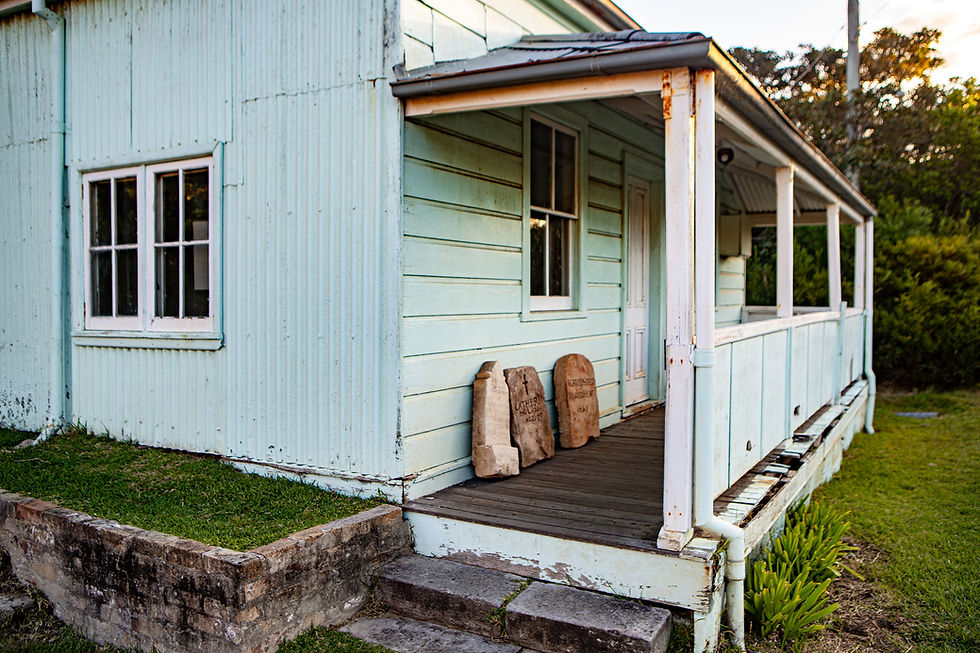
The haunted zones across the site include: a hospital ward with whispered voices; the Gravediggers’ Cottage (which overlooks the unmarked First Quarantine Cemetery) where ‘Sam’ the gravedigger roams the rooms and sometimes shoves people (especially women); the Autopsy Room in the morgue; and the Shower Block for new arrivals in which a uniformed quarantine officer named ‘William’ checks whether new interns are actually washing themselves.
Wakehurst Parkway, Garigal National Park
Wakehurst Parkway is a 14km road that traverses Garigal National Park, running south-west from North Narrabeen through Oxford Falls bushland, then turns due south and ascends to Frenchs Forest. From there it continues south to Seaforth, but it is the forested northern section that follows Middle Creek to Narrabeen Lagoon that has attracted a reputation as one of Australia’s “most haunted roads”.
Prone to flooding and dimly lit, the ghost sightings tend to centre on two apparitions who appear late at night: one a young woman named ‘Kelly’ (for unknown reasons), sometimes seen in a white dress or pyjamas; the other an elderly woman wearing a nun’s habit. However, the descriptions overlap and Kelly is sometimes observed wearing the nun’s uniform.
Furthermore, some reports state Kelly is a hitch-hiker, or, alarmingly, appears suddenly wandering in the middle of the road, apparently a dazed victim of a car crash. Then, if picked up, she refuses to get out of the car and grabs the steering wheel and turns the vehicle, causing it to run off the road and crash into trees.
Others recall Kelly appearing to stand on the roadside near Middle Creek Bridge, then, after they drive past (or sometimes through her!), she reappears in the rear-view mirror as if sitting in the back seat of the driver’s car.
It has recently been suggested Kelly and the old woman are the same but confusion lies in the interpretation of her clothing. Instead of a nun, perhaps Kelly was a nurse, wearing a uniform typical of the medical staff working at the Quarantine Station in the early 1900s.
A nun’s habit consists of an ankle-length black tunic, a white scapular (square-shaped cloth) covering the neck and shoulders, and a veil covering the head – white veil for novices, black for professed.
Whereas an Australian nurse’s uniform from the early 20th century typically consisted of a navy blue ankle-length dress (black for trainees), white collars and a white starched apron, and a white veil for those senior in rank, white caps for juniors.

Incidentally, there are two movies on the aforementioned locations: The Quarantine Hauntings, a horror drama, and The Parkway Hauntings, a documentary investigation, both created by the same filmmaking duo, Bianca Biasi and Arnold Perez, and released in 2015.
Gore Hill Memorial Cemetery, Gore Hill, St Leonards
Adjacent to Royal North Shore Hospital, the Heritage-Listed 5.8 hectare graveyard was established in May 1868 and is one of metropolitan Sydney’s oldest surviving cemeteries. It holds remnants and monuments transferred from much older but lost Sydney burial grounds, including the Devonshire Street Cemetery (in which bodies were dug up and relocated to make room for Central Station).
The area was originally part of William Gore’s 150-acre colonial property, Artarmon Farm, on which convicts laboured. The cemetery was founded by politician William Tunks, the first Mayor of St Leonards and re-elected 15 times, on a portion of Gore’s original land grant, years after Gore's financial insolvency and death. (Two coffins containing the remains of Gore and one of his daughters were found unburied in a bushy area of the property after his 1845 death. They were later interred.)
Tunks wanted a landscaped attractive garden setting for the new cemetery, the first on Sydney’s North Shore, instead of a gloomy graveyard. When Tunks died in 1883, he was the first to be buried in the Church of England section of the grounds.
14,456 burials took place between the first interment in 1877 and its last in 1974 (ashes are now accepted), although most took place in the three decades from 1900 - 1930. Only 8,000 graves feature headstones, the rest, including human remains transferred from the redeveloped Devonshire St Cemetery, are unmarked.

Australia’s first Saint, Mary MacKillop (who is closely associated with the much-haunted Adelaide Gaol), was buried in the Catholic section from 1909 to 1914, when her remains were exhumed and transferred to the Mary MacKillop Memorial Chapel in North Sydney. MacKillop was relocated because her gravesite was deteriorating and devout Catholics were scooping dirt from her grave site as a souvenir to pray on. There was anxiety they’d eventually dig down far enough to expose her coffin.
Ghost-watchers claim there are resident spectres in Gore Hill Cemetery, perhaps unfortunate patients from Royal North Shore Hospital alongside. Among these were several victims of the deadly 1918 Spanish Flu pandemic, which caused 3,902 deaths in Sydney of the estimated 20,000 nationwide (and 20 million worldwide).
Also among the spectres reported are “a woman in black Victorian garb perhaps dating from the 1870s”, said to be mourning a child, and “the dark silhouette of a walking old man.”
Royal North Shore Hospital, St Leonards
According to an Oct 2025 article in the North Shore Lorikeet, “one former receptionist told the Lorikeet she often felt quite ‘spooked’ leaving the premises late at night when she worked there in the 1990s.
‘I worked in an old dark building that is now gone, and I used to have to go into the medical records unit in there. It was so creepy down there because the walls would creak and it would almost feel like the walls were talking to you. My hair would stand up on the back of my neck. You’d just feel a presence. And there were all these underground tunnels that would connect different buildings at RNSH back then too.’”
Tarella House, Cammeray
Tarella House, situated between Amherst Rd and the Warringah Freeway in Cammeray Village, is a State Heritage-Listed home built in 1886 by Sir Joseph Palmer Abbott (1842-1901), solicitor and politician.

Now a childcare centre after extensive renovations in 2016, the historic premises are purportedly haunted by two children.
According to the North Shore Lorikeet, quoting a now-deleted blog by Sydney ‘ghost hunter’ Daniel Phillips on Sydney Ghost Tours’ website, Phillips “‘claims it is a focal point for eerie phenomena’ such as the apparitions of two children who died of cholera in the 1800s, alarms being activated for no ostensible reason, and the smell of cigars and French cooking emanating from unused rooms at strange times.”
However, according to Family Search, all of Sir Abbott’s seven children from two marriages survived well into adulthood.
Furthermore, Sydney has never had a sustained, locally transmitted cholera epidemic. During the 19th-century cholera pandemics, ships arriving in Sydney Harbour frequently reported cholera cases and deaths among passengers. However, strict quarantine measures utilising the Quarantine Station at North Head prevented these infections from establishing themselves locally in Sydney.
Quinton Road Ghost, North Manly
Northern Beaches Council also identify seven haunted sites along the coastal region, including the aforementioned Quarantine Station and Wakehurst Parkway.
Among these are The Quinton Road Ghost Story. In the 1970s, residents of a house on Quinton Road claimed they were being terrorized by a ghost in heavy boots that would stomp through their homes at night. The source of the stomping has been attributed to the spirit of a fisherman who drowned in the area. However, a more fanciful version claims it’s the ghost of Pirate Captain Blackjack Vaughan, who allegedly hid in caves on the North Manly seafront.
Northern Beaches Council asserts, “Captain Blackjack Vaughan was described as one of the vilest and cruellest pirates ever known. He was captured in England in 1810, sentenced to life imprisonment and transported to Sydney as a convict. He promptly escaped and returned to a life of piracy.”

The nearest seafront caves would be the rocky outcrop of Queenscliff headland, approximately 2km to the north-east. These aren’t caves but alcoves worn into the rock for centuries by pounding seas. There is a tunnel through Queenscliff headland, known as the Manly Wormhole, a narrow 40-metre channel.
However, this was dug through the sandstone rock in 1908 by fisher-folk funded by a local property investor, to use as a shortcut between Queenscliff Beach to the south and Freshwater Beach to the north. It was safer than having to clamber up the steep, treacherous cliff face and walk over the headland. There were no pre-existing natural caves through the Queenscliff headland before the Manly Wormhole was created.
Gladesville Mental Hospital, Bedlam Point, Gladesville
Originally known as Tarban Creek Lunatic Asylum, Australia’s first mental hospital was built on the aptly-named Bedlam Point beside Parramatta River. Opened in 1838 with 60 patients for a new trend of humanely treating the mentally afflicted, by 1844 there were 148 inmates and rumours of cruel punishments including prolonged restraints and sexual abuse of female patients - which persisted for decades.
A July 1850 Medical Board of Inquiry convened to investigate the deaths of two patients found that the institution was to blame. In Jan 1869, new methods of treating psychiatric disorders prompted a name change to Hospital for the Insane, to suggest a departure from the previous tactic of isolating mentally ill people from society. However, brutal treatment continued, with patients detained for ludicrous disorders such as ‘sexual intemperance’, ‘overwork’, ‘sun stroke’ and ‘nostalgia’, often treated with repeat electric shocks.

There were many deaths, including a few employees attacked by patients. Records reveal 1,228 patients are buried on the north-eastern corner of the 25.4 hectare site in unmarked graves. Although the names of 923 of the deceased are listed on Health Department records, the identities of those in 305 graves are untraceable.
Their ghosts are said to wander the asylum grounds, parts of which are now derelict.
In the 2011 Head On Photo Festival, photographer Yvette Worboys held an exhibition of the hospital’s derelict buildings, titled ‘Ghosts’. She claimed psychics detected a spectral presence in her photo of a white brick wall covered in vines, loitering to the left of an empty doorway.


