


The History of Randwick Racecourse
The Fascinating History Behind Australia’s Oldest Official Horse Racing Venue, Randwick Racecourse.
By ALEC SMART
Randwick Racecourse, Sydney's premier horse racing venue, has an extensive history as Australia’s oldest official venue for watching the ‘nags’ gallop along the ‘turf’. Land was designated for the course by Governor Bourke in January 1833. Featuring a 2,224-metre clockwise track with a 410-metre straight, Randwick began hosting races in June 1833.
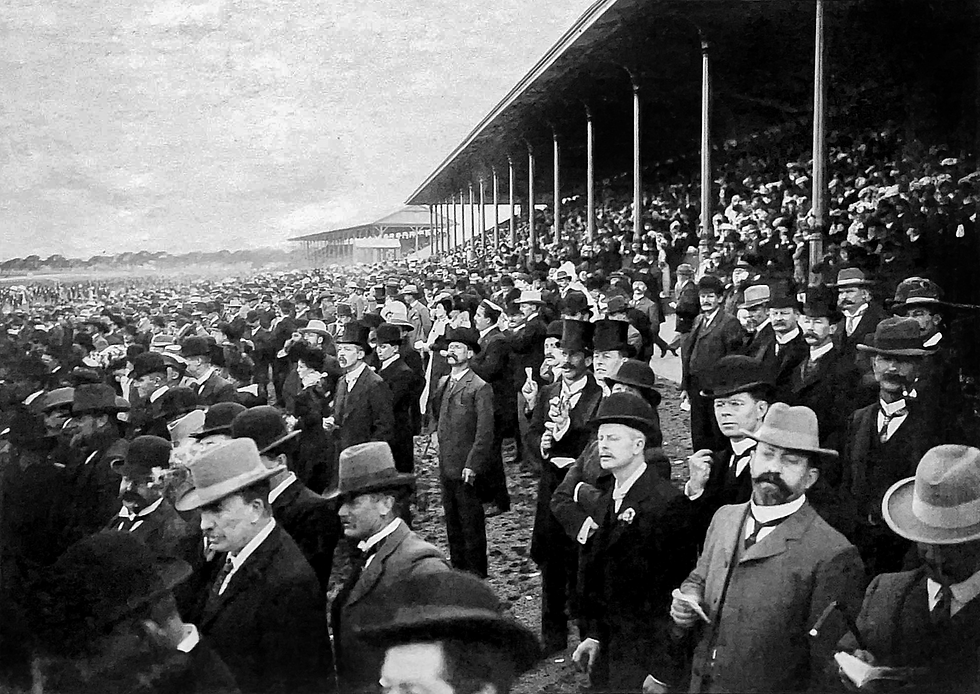
However, it’s not the oldest continually-operating horse racing track in the Southern Hemisphere – that is the Champ de Mars Racecourse in Port Louis, Mauritius, which was inaugurated in June 1812.
Horse racing has been a human pastime since horses were first domesticated. Chester Racecourse in Cheshire, England, is officially recognised by Guinness World Records as the "oldest racecourse still in operation". Historians believe organised horse racing in Chester began in 1539, although some sources give an alternative date of 1512 for Chester’s first races.
Several other race tracks around Sydney pre-dated Randwick but ceased operating for a number of reasons. The most famous was Hyde Park Racecourse in the city centre, established in 1810 by officers of the 73rd Regiment.
The 73rd was a British Army infantry unit that arrived with Governor Lachlan Macquarie that year to replace the notorious New South Wales ‘Rum’ Corps – the garrison behind the Rum Rebellion military coup. The 73rd Regiment introduced horse racing to Australia to encourage better breeding of equine livestock.
Sydney’s first official racing event took place in 1810 over three days – 15, 17, 19 October - with a 50-guinea silver cup as a prize.
It was won by won by ‘Gig’, a grey gelding ridden by William Charles Wentworth, the famous explorer who, along with Gregory Blaxland and William Lawson, were the first Europeans to trek across the Blue Mountains in 1813.
Incidentally, according to the Australian Turf Club, for the inaugural race event “the grandstand was positioned in such a way that Mrs Macquarie did not get the sun in her eyes, and this is why we race clockwise in NSW.”
Most other states - Victoria, South Australia, Tasmania and Western Australia (but not Queensland) – and indeed most other countries race horses in an anti-clockwise direction.
Horses competing in different states of Australia must be able to adapt to this change of bearing.
Britain also has a few clockwise courses, such as Ascot, widely considered the most famous and prestigious horse racing track in the world, with historic ties to the British Royal Family since its foundation in 1711.
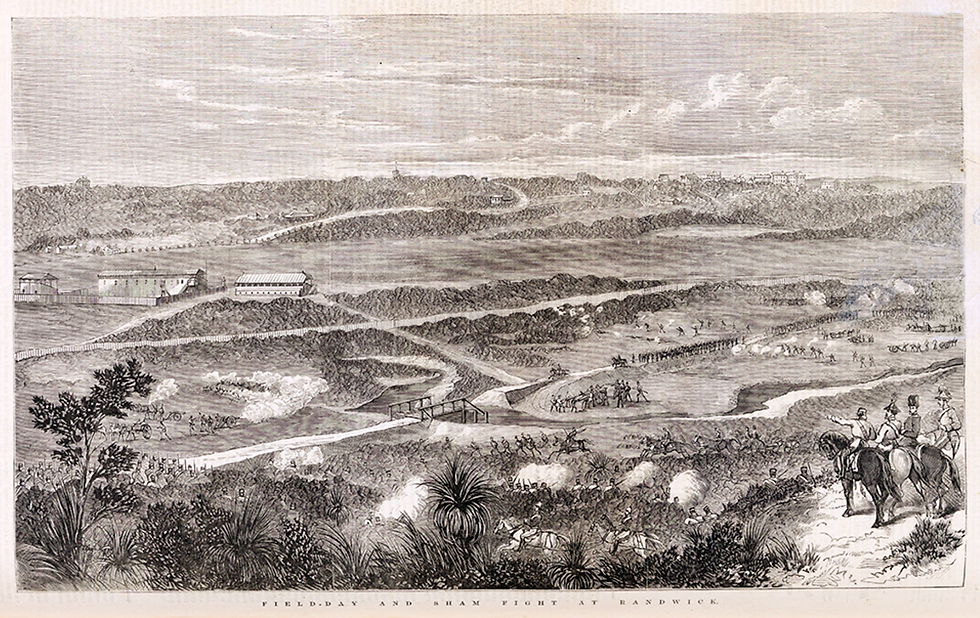
Races took place at the Market Street end of Hyde Park, and although official meetings ended in 1821, Hyde Park as a racetrack effectively ceased operation in 1825, following a ban on official racing issued by then-Governor Thomas Brisbane.
In December 1832, a group of prominent landowners, led by Irish immigrant John Jamison, a distinguished doctor and landowner, petitioned new Governor Richard Bourke for a portion of land in the area then-known as Coogee Hills to be set aside for development of a racecourse.
A suitable site was chosen, which was visited and approved by Surveyor-General Thomas Mitchell and Colonial Secretary Edward Deas Thompson, and convict labour was utilised to clear the flora and prepare the ground.
The new racecourse was close to a walking track that was known as ‘Mudbank’, an Aboriginal path that ran parallel to the coast through wetlands, sand dunes and forests through their historic hunting and fishing grounds.
Traversing the territories of the Gadigal and Kamaygal clans, ‘Mudbank’ coursed from the southern edge of the burgeoning Sydney settlement to the fishing town of Booralee (named after the Indigenous word for the area, now replaced by the suburb of Botany) on the north shore of Kamay, which Captain Cook renamed Botany Bay.
Mudbank path was widened to a road in 1813 and informally known as ‘Botany Rd’ from around 1840, and was eventually surveyed in 1863 and upgraded to a road sealed with macadam (stone dust mixed with water into a paste). It ran between the newly-emerging suburbs of Redfern at the northern end to Booralee in the south (both constituted 1859) and enabled market gardeners, oyster collectors, pig farmers and new cottage industries to transport their produce to the city. Part of this route came to be known as Corduroy Road, due to the ridges cut through swampy sections to facilitate drainage.
The 202-acre site chosen for the earliest incarnation of Randwick Racecourse was initially known as ‘The Sandy Course’, because of its high volume of sand, due to its close proximity to Coogee Beach. Unfortunately, this loose terrain made it difficult to maintain, and because the district was sparsely populated and remote from the main settlement of Sydney, the track eventually deteriorated to the point it was unsafe for horses.
For 20 years, between 1838-58, racing on the Coogee Hills’ track ceased altogether.

Randwick, whose name derived from a property owned by Simeon Henry Pearce, an English surveyor who arrived in Australia in 1841, was proclaimed as a Municipality on 22 February 1859.
In 1858, the Australian Jockey Club (previously the Australian Race Committee, and now merged with the Australian Turf Club) decided to invest in Randwick Racecourse, which they subsequently chose as their headquarters.
Until then, the AJC hosted races on William Wentworth’s land at Homebush (1841-1859). Randwick racetrack was upgraded to a high-standard course with fresh turf and the construction of a 700-seat grandstand and new running rails around the track.
The first races were held on Weds 29 – Fri 31 May 1860, entertaining a crowd of over 6,000. The first Sydney Cup race was run in May 1866, the first Australian Derby in 1861 (which, in 1929, was won by the famous Phar Lap, a cultural icon that won 37 of 51 races, including the 1930 Melbourne Cup).
Over the next decade, two new grandstands were erected (demolished and replaced by larger stands in the 1880s) and the original 700-seat stand was replaced in 1875 with a larger stand.
In 1880, NSW Government Railways, which managed Sydney's steam-powered trams, constructed the network’s first extension to Alison Rd, Randwick, to cater to racegoers as well as service the community. By 1900 the popularity of the racecourse necessitated the construction of a new tram stop directly outside the stadium.


