


Saving Cleveland House
Sydney’s oldest surviving manor, Cleveland House, has faced mounting deterioration despite decades of heritage recognition
By Rita Bratovich
Once Sydney’s oldest home and a rare example of early colonial architecture, Cleveland House has long suffered from neglect.

“This old grey house, now part of a group of buildings, is, from an Australian point of view, very old indeed.” This quote is from The Freemasons Journal, 1938 in reference to Cleveland House — which has since aged another 87 years!
Occupying the block of land between 51 Buckingham Street and 146-164 Chalmers Street in Surry Hills, this impressive two-storey mansion has a history dating back to early settlement. However, if you were to walk past it today you would do exactly that - walk past.
Surrounded by crude wire fencing, graffitied, rusting and crumbling, this important heritage-listed landmark has been allowed to fall into dereliction. Rudimentary and emergency repair work has been conducted over the last two decades, but the serious maintenance work required has been delayed by ping ponging DAs and approvals.
Cleveland House is not only a beautiful example of quality architecture, it is also testament to two convict-cum-free settler success stories.

Daniel Cooper was “transported” to Sydney from England in 1816, but received a pardon two years later. A shrewd businessman, Cooper immediately began building his empire, beginning with a pub and a store and expanding to include a shipping company, a brewery, and eventually the large, notable trading company, Cooper & Levey.
By the early 1820s, Cooper was a very wealthy and very prominent figure within the colony. In around 1823, the now married Cooper commissioned another successful ex-convict, respected architect Francis Greenway, to design a residence on his five hectare parcel of land in what is now Surry Hills.
The result was a stunning two-storey mansion in the Colonial Georgian style. Made from brick on stone foundations, it featured a wrap-around verandah supported by stone pillars, an iron roof, ten large rooms, an enormous basement with four cellars, a beautiful cedar interior staircase, stone exterior staircase, and verdant, landscaped gardens. The external rendering was stucco. Several outbuildings surrounded the main house and helped create courtyards. Built on a hill with very few other structures around, the magnificent mansion offered views down to the harbour.
![Turning the first turf of the first railway in the Australasian colonies at Redfern, Sydney, N.S.W. 3rd July 1850 By John Rae From the collections of the State Library of New South Wales [a928444 _ ML 244] (Mitchell Libra](https://static.wixstatic.com/media/badb9a_ff51eff0c23d4921871bc084a9e04afd~mv2.jpg/v1/fill/w_980,h_661,al_c,q_85,usm_0.66_1.00_0.01,enc_avif,quality_auto/badb9a_ff51eff0c23d4921871bc084a9e04afd~mv2.jpg)
Alas, Cooper and his wife, Hannah, separated in 1829, having spent only five years at Cleveland House. The house was rented out so that Hannah would have an income.
Meanwhile, the rest of Sydney colony continued to develop. Despite its distance from the rest of the world, Australia was an early adopter of technologies, including the invention of steam engines.
By the mid 1850s, a railway line had been established in Sydney from Circular Quay to Parramatta. A terminus was built at Redfern in 1855 (which later became Central Station). Surry Hills was quickly urbanising. Daniel Cooper died in 1853 and his estate was sold and subdivided into eight blocks — the main house and out buildings remained on one block.
![By Adrian Hall Contributed By City of Sydney Archives [SRC1040]](https://static.wixstatic.com/media/badb9a_8393ddaf91a64ff687062c15a3b781bb~mv2.jpg/v1/fill/w_958,h_766,al_c,q_85,enc_avif,quality_auto/badb9a_8393ddaf91a64ff687062c15a3b781bb~mv2.jpg)
From then on, Cleveland House changed ownership and experienced a wide variety of tenancies and uses. It was a ladies college, a boarding house, a laundry, a group of apartments. In 1903 it was owned by Sisters of the Good Samaritan of the Order of St Benedict and functioned as a school and convent. Then the Franciscan Missionaries of Mary purchased it in 1946, residing there for around 12 years before it was bought by NSW Society for Crippled Children in 1958 and used as a hospital.
Current owners, LGS Enterprises Pty Ltd, acquired the property in 1988, demolishing the out buildings and a further subdividing the land. A 103 unit residential apartment block called Princes Gardens was built adjacent to Cleveland House.
Meanwhile, Cleveland House continued to host a diverse range of tenants, including a solicitor's firm and an importer/exporter of dental supplies.

InVivo Communications, medical education company and subsidiary of LGS Enterprises, moved in in 1997 and still lists 51 Buckingham Street as its address, even though Cleveland House is said to be vacant.
Despite its historical significance and the threat imposed by repeated change of tenancy and development, it took until April 1999 for Cleveland House to be registered with New South Wales Heritage Council.
Even with oversight by the Heritage Council, the once glorious manor house is in severe decline. As far back as 2010, the owner was ordered to repair the roof, drainage system, gutters, downpipes and flashing to prevent water damage to the building. A grant of $50,000 was awarded in 2013 so that repair work could be done. The verandah floors had already collapsed due to improper water drainage.
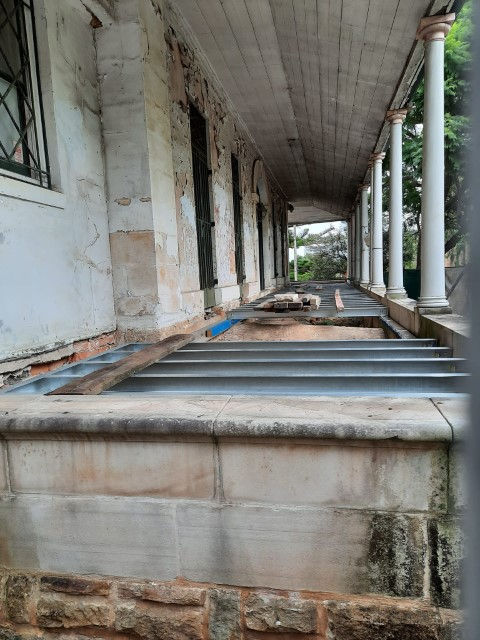
Whether or not this work was ever completed, Cleveland House continues to display signs of dilapidation. An integrated development application (IDA) submitted in 2019 is still awaiting approval on all elements.
Being registered with Heritage NSW indicates that Cleveland House has state significance as a historical building.
Local residents are keen to see it repaired and actually used in a way that benefits the community: a museum, cafe, venue, cor ommunity centre. Something that honours its past.

