


Anthony Albanese and Marrickville
- Jul 15
- 4 min read
From a Council Flat to The Lodge, Why Marrickville Has Always Been Home for Anthony Albanese
By Lucy Pearson
There is a particular kind of politician who speaks about where they come from as though it were a campaign prop - a useful origin story to be dusted off at election time and packed away when the bunting comes down. Anthony Albanese is not that politician. For Australia's Prime Minister Anthony Albanese, Marrickville is not a backdrop. It is, in the most literal sense, home.
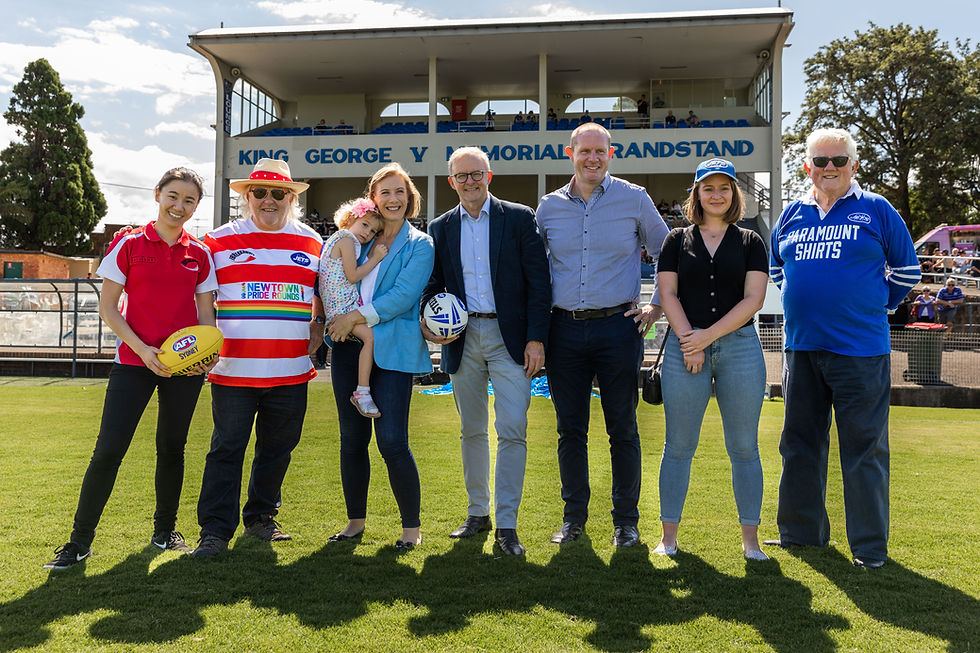
Albanese was born in 1963 and raised a few suburbs away in Camperdown, in a council flat on Pyrmont Bridge Road, by his mother Maryanne, a single woman living on a disability pension and managing severe rheumatoid arthritis. The inner west of Sydney in those years was a gritty, working-class patchwork of fibro cottages, factory workers, migrants, and Catholic parishes. It was, by any measure, a hard place to grow up without money. But it was also a place with genuine community, and it gave the boy who would one day become Prime Minister a set of values - about fairness, solidarity, and the dignity of ordinary people - that have never left him.
By the time Albanese was 26, he had already planted his flag in Marrickville. In early 1990, he appeared on property title records as a "political party official," buying a two-bedroom semi in Marrickville for $146,000. It was his first home, and it would not be his last in the suburb. After a brief stint in Newtown, he sold up and returned to Marrickville in 2006, purchasing a Federation bungalow with a contemporary rear extension and a swimming pool - about 200 metres up the road from his first buy - for $997,500. That house remains his primary residence. In a political class that has largely decamped to the harbourside or the hills, Albanese's loyalty to the inner west is striking. He has, by his own account, never lived anywhere else.

The suburb to which he has remained so attached was recently voted one of the ‘coolest’ suburbs in the world. Marrickville sits roughly seven kilometres south-west of the CBD, a dense, diverse pocket of the Inner West whose main drag - Marrickville Road - has, over the decades, been shaped by successive waves of immigration: Greek, Italian, Vietnamese, Portuguese, more recently Ethiopian and Bangladeshi. It is the kind of place where a souvlaki shop and a Vietnamese bakery share a block with a natural wine bar and a recording studio, where the terrace houses back onto light industrial lots, and where the local pub has, depending on the era, hosted everything from shearing union meetings to post-punk bands. Albanese understands this texture because he has lived inside it. He has spoken warmly of growing up in Marrickville and seeing bands - The Sunnyboys and New Order among them. His attachment to the suburb is cultural as much as political.
That political dimension runs deep, however. Albanese has represented the seat of Grayndler - which includes Marrickville and surrounding inner-west suburbs - since 1996. It is, in parliamentary terms, an extraordinary tenure: that’s three decades representing the community he grew up beside. His electorate office on Marrickville Road was first opened by former Prime Minister Gough Whitlam in 1993 as the office of Albanese's predecessor, Jeannette McHugh. That lineage - from Whitlam to McHugh to Albanese - tells a story about what kind of place Marrickville is and what kind of politics it has historically demanded: progressive, community-rooted, and fiercely protective of working people.
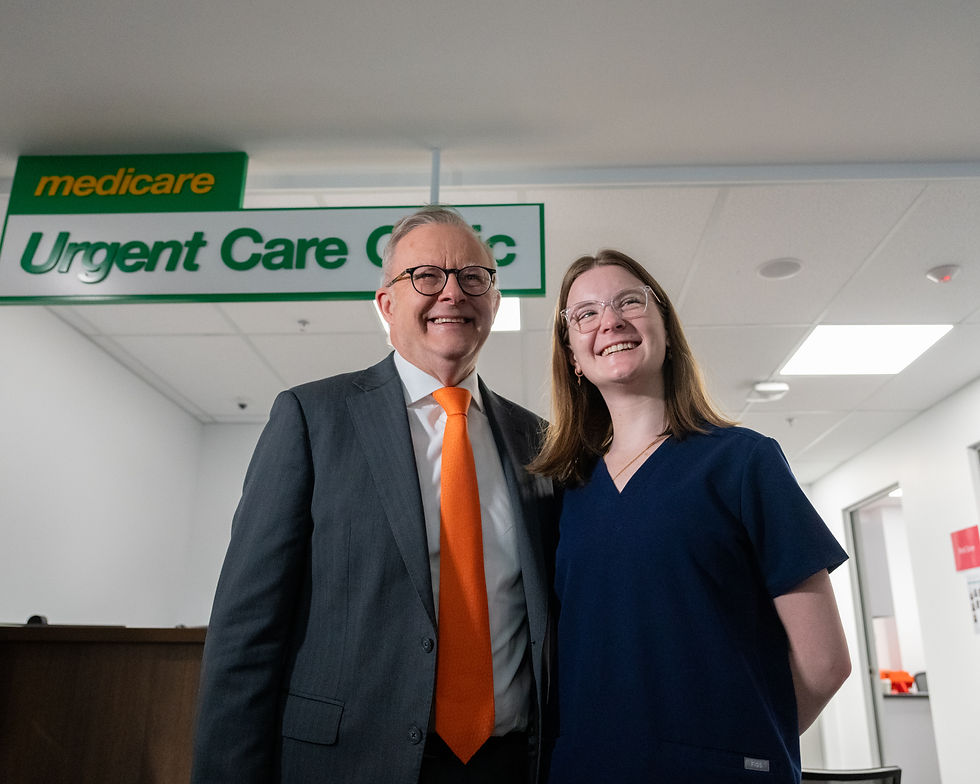
The office became, in more recent years, a flashpoint. Pro-Palestinian protesters demonstrated outside it continuously for over a year, eventually leading Albanese to close the lease, citing disruption to a neighbouring church whose car park was shared with the office and whose parishioners were being harassed at funerals. It was an uncomfortable episode for a Prime Minister who had built his identity around being accessible and local - a man who could be found at the Henson Park Hotel or unpacking his dishwasher at home when a journalist came to call. But it also illustrated, in its way, the kind of suburb Marrickville is: politically engaged, vocal, and disinclined to be quiet when it has something to say.
More Than Just A Marrickville Resident
The connection between Albanese and Marrickville is not merely residential. His former wife, Carmel Tebbutt, was herself the state Member for Marrickville from 2005 to 2015, serving as NSW Deputy Premier from 2008 to 2011. For a period, husband and wife represented overlapping layers of the same community - federal and state, Grayndler and Marrickville - a remarkable double act that reflected just how thoroughly the suburb had become the Albanese family's political territory.

When Albanese stood before the nation on election night in May 2022 and declared that a boy from a council flat in the inner west had just become Prime Minister of Australia, it was a genuinely moving moment - not because the story was unfamiliar, but because those who knew Marrickville understood exactly what he meant. He said that night: "It says a lot about our great country that a son of a single mum who was a disability pensioner, who grew up in public housing down the road in Camperdown, can stand before you tonight as Australia's Prime Minister." He won again in 2025 with a significantly increased majority.
The inner west made Anthony Albanese. And Albanese, in turn, has spent the better part of his adult life making the case - in Canberra and at home on Marrickville Road - that places like the inner west matter.


