


The Unsolved Killara Murder
The unsolved Killara cold case that shocked Ku-ring-gai: the murder of Leopoldine Hacker
By Elliot Lindsay
On the warm Friday evening of December 14, 1951, the tyres of a black sedan screeched into the driveway of a grand home at 36 Northcote Avenue, Killara. Neighbours looked up from their dinners. Something was wrong, and to this day, this Killara murder case remains unsolved.
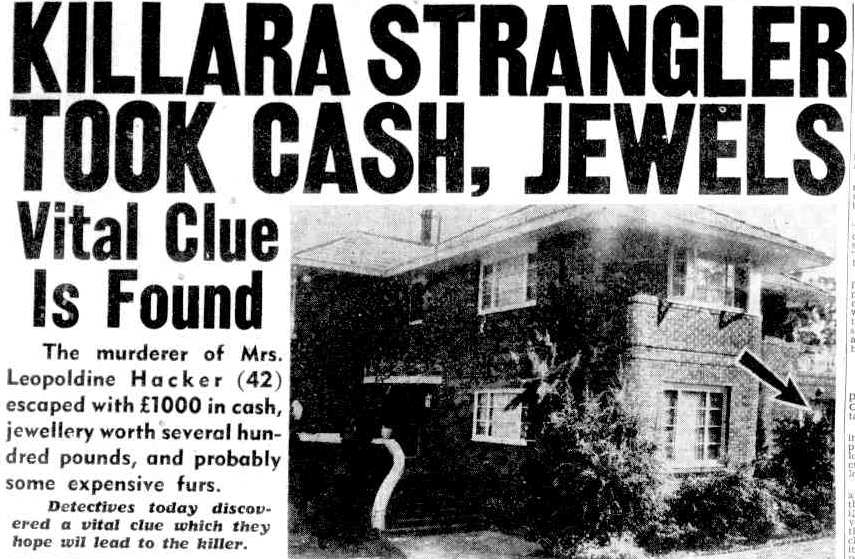
The driver, wealthy motor dealer Arthur Abraham Hacker, leapt from the car and hurried toward the house. Inside, hidden behind the elegant brick façade and manicured gardens of one of Killara’s finest homes, a scene of shocking violence awaited him.
His wife, Leopoldine Hacker, lay dead in the sunroom. She had been battered savagely about the head and strangled with a cord torn from her husband’s pyjamas. More than seventy years later, the murderer has never been identified. The crime remains one of Sydney’s great unsolved mysteries.
A Viennese Couple in Sydney’s North Shore
In the years after World War II, Killara was one of Sydney’s most desirable suburbs. The broad leafy avenues around the Pacific Highway were lined with substantial homes hidden behind hedges and flowering gardens. Northcote Avenue, running quietly west from the highway toward Gordon Golf Course, was a world away from the grime and congestion of inner Sydney.

Arthur and Leopoldine Hacker had arrived in Australia from Vienna in 1939. By 1951, Arthur Hacker had become managing director of Century Motors, one of Sydney’s biggest used-car firms, with premises in William Street and Broadway.
The couple lived in luxury at the corner of Northcote Avenue and Arthur Street. Their large two-storey home sat on extensive grounds complete with a tennis court, landscaped gardens, stone patios, and expensive furnishings gathered carefully over years. Neighbours remembered crystal chandeliers, polished timber interiors, wall-to-wall carpets, and Leopoldine’s collection of dresses, jewellery, and furs.
Yet despite their wealth, the Hackers remained somewhat isolated. Neighbour Helen Rankin later observed that many locals still regarded them as “foreigners.” Leopoldine, described repeatedly by newspapers as an “attractive Viennese brunette,” spent much of her time alone in the house while Arthur worked long hours in the city.
In December 1951, the couple were searching for domestic help. Advertisements had been placed for a housekeeper-cook and gardener. That detail would become one of the enduring mysteries of the case.
The Last Morning
On the morning of Friday, December 14, Arthur Hacker left the house shortly before 8 a.m.
Before leaving, he arranged to meet Leopoldine at the Moccador Café in Market Street that evening. They were to dine later with relatives at Cammeray. Arthur planned to surprise his wife with an expensive diamond bracelet he had purchased only the day before.
As he drove away from 36 Northcote Avenue, Leopoldine stood in the garden and waved goodbye.
It was the last time he saw her alive.
That morning, an electrical contractor visited the house around 9 a.m. and spoke with Leopoldine in the garden. Later, neighbours saw her watering the lawns and tennis court. At around 11.15 a.m., a woman living nearby noticed Leopoldine talking to a heavily built middle-aged man outside the property. The man wore light-coloured trousers.
He was never identified.
At approximately 2.30 p.m., two local girls walked past the Hacker residence and noticed water pouring from a detached garden hose. They turned off the tap and knocked at the back door and sunroom.
Nobody answered. Inside the house, Leopoldine Hacker was already dead.
The Discovery
At 5.30 p.m., Arthur Hacker waited outside the Moccador Café in Market Street. Leopoldine never arrived. By 6.15 p.m., he was alarmed. He attempted to ring the house from a nearby hotel at the corner of Pitt and Market Streets, but there was no answer. Driving north across the Sydney Harbour Bridge, he stopped again at North Sydney Post Office to make another call. Still no answer. He sped toward Killara.

Neighbouring children later remembered hearing the tyres of his car screech as he turned into Northcote Avenue shortly after 6.30 p.m. Something immediately struck him as wrong.
The garden sprinklers were still running. One garage door stood open.
Inside the kitchen, furniture was overturned and blood splashed across the floor and walls. A chair lay on its side. Screws had been ripped from the kitchen table during a violent struggle. Bloodstained curling pins, a packet of cornflakes, and a salt shaker littered the floor.
Leopoldine’s body lay in the adjoining sunroom beside a bloodstained couch.
She had fought desperately for her life.
Her head was covered in congealed blood. Around her neck was a doubled pyjama cord twisted tightly into a strangler’s noose. Arthur ran from the house screaming for help.
“One of the Most Brutal Murders in Sydney History”
Within hours, Northcote Avenue was swarming with police cars, detectives, reporters, and photographers. The quiet North Shore suburb became the centre of one of the biggest murder investigations in Sydney history.
The crime scene horrified even experienced detectives.
Police believed Leopoldine had been attacked in the kitchen, possibly by someone she willingly admitted into the house. The killer battered her repeatedly with what investigators believed was a .25 calibre Browning automatic pistol. A pistol magazine containing four live cartridges and strands of hair was found on the kitchen floor.
Bleeding heavily, Leopoldine staggered into the sunroom. There, investigators believed, the killer strangled her after realising she was still alive. The upstairs bedrooms had been ransacked. Jewellery, cash, mink coats, and furs valued at more than £5000 were missing. Detectives interviewed hundreds of people.
A mysterious woman who answered the Hackers’ advertisement for domestic help vanished before a scheduled interview with Arthur Hacker at Century Motors. Two young men seen near the property that morning were never identified. Nor was the middle-aged man seen speaking to Leopoldine in the garden shortly before the murder.
Police searched migrant hostels, questioned former employees, travelled to Katoomba and Newcastle chasing leads, and circulated photographs of stolen jewellery internationally.
Scotland Yard joined the investigation. So did the FBI.
Yet every promising clue collapsed.
The Coroner’s Verdict
On July 15, 1952, an inquest opened at Central Court. Arthur Hacker sat grim-faced as detectives and forensic experts reconstructed the killing. Scientific Bureau detective Norman Merchant described the bloodstained kitchen and the violent struggle that had moved into the sunroom. Police admitted they had traced leads “into almost every part of the world.”
But they were no closer to solving the murder. Coroner F. G. Pocock delivered the inevitable verdict: “Murder by a person or persons unknown.”
A Mystery That Never Died
As the years passed, the Leopoldine Hacker murder became woven into Sydney’s folklore of unsolved crime. Rewards were offered. Rumours flourished. Suspects came and went. Nothing stuck.

Today, motorists pass quietly along Northcote Avenue beneath the shade of old trees and past elegant homes hidden behind trimmed hedges, unaware that one of Sydney’s most savage and baffling murders unfolded there on a warm summer afternoon in 1951. The witnesses are now gone. The detectives, neighbours, reporters, and schoolgirls who once watched the drama unfold have all passed into history.
Only the old Hacker mansion remains.
Though decades of renovations and redecoration have altered its appearance, the house still stands as the last silent witness to the crime, like a traumatised survivor desperately attempting to conceal its scars and begin life anew. Yet unlike the people connected to the tragedy, the house cannot escape into death or forget what happened within its walls. Generation after generation has passed through its rooms, many unaware that beneath the polished floors and modern interiors lies the memory of terrible violence.
Somewhere inside that house, Leopoldine Hacker took her final breath. The killer was never caught. Perhaps he walked those quiet streets again in later years. Perhaps he even returned to Northcote Avenue and stood once more before the scene of his crime. If he did, the old house could say nothing. It could only remain there in silence, holding forever the secret of who murdered Leopoldine Hacker.
--------------------
This article was written in memory of Jo Harris, born Joan Helene Law at Killara in 1934, who lived opposite the Hacker residence and witnessed the events surrounding the murder of Leopoldine Hacker in December 1951. Her mother was among the first people to enter the house after Arthur Hacker discovered his wife’s body.
In later life, Jo became a devoted member of the Ku-ring-gai Historical Society and contributed greatly to the preservation of local history and community life. She passed away in August 2025 and is greatly missed.
Read more St Ives True Crime Stories HERE.


