


Matt Murphy: Author Uncovering Australia’s Absurd History
Updated: Apr 18
From Convicts to Chaos, Matt Murphy Explores 237 Strange Stories Behind Australia Day
By ALEC SMART
Matt Murphy is a firefighter, teacher, historian, soccer player and author (although not necessarily in that order). He is renowned for writing witty, somewhat irreverent history books on colonial-era Australia that highlight absurd events and characters, and he has a new book out: Straya Day.

Based in Sydney, Murphy has authored four books, the latter three - Rum: A Distilled History of Colonial Australia (2021), Gold (2025), and Straya Day (2026) - published by the distinguished Harper Collins (the world’s second-largest consumer book publisher) plus his debut, Weight of Evidence (2013)
He is no relation to fellow author and ABC (i.e. American Broadcasting Company) legal analyst Matt Murphy, who happens to share the same name. Nor did he sing for a band called The Wombats.
He’s also a contributor to Neighbourhood Media community magazines – you’ll find some of his articles here, here and here.
According to his online bio: “At school, Matt Murphy failed English and couldn't see the point of history. He became a firie and has been serving in Sydney's inner city for 33 years. He is now also a part-time historian and teacher, tolerating the attitudes of kids towards history that he used to share…
“Matt's younger self would be aghast that he is now writing history books but be consoled by the absurdist voice old Matt has achieved. Matt also can't believe he has to write his own bio.”
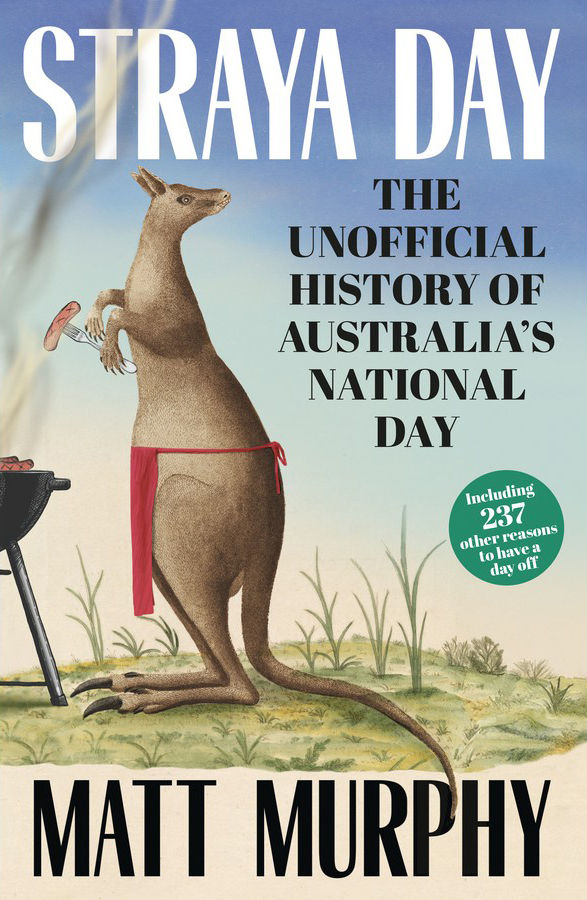
Straya Day is described as “the unofficial history of Australia's national day since the first contentious one, thereby offering 237 other reasons for a day off.”
Why 237? Well, it’s 237 years since British colonists arrived on 18-20 January 1788 to establish their penal colony on the east coast of the unexplored land mass known as both New South Wales (east side) and New Holland (west side).
They anchored in Botany Bay, an unsuitable cove recommended by Captain Cook when he visited 18 years earlier. In fact, Botany Bay was so unsuitable, with limited shelter and just a trickle of fresh water, that the 1400 immigrants in 11 vessels – including nine transporting 750+ prisoners, three carrying provisions, and two small Royal Navy battleships packed with 250 armed Marines – relocated north to Port Jackson.
They raised the British Union Jack flag on 26 January 1788 in Sydney Cove – which was why that date was eventually chosen, 147 years later, as the official National Day of Australia, aka ‘Straya Day’, in 1935.
Previously, Queensland celebrated it on 6 June; Tasmania celebrated it on Regatta Day (1 Dec from 1838-78, then from 1879 a Monday in Jan or Feb); Western Australia on the first Monday in June; and South Australia on 22 Jan (until 1910 when they moved the date to the 26 Jan).
In 1915, an official committee endorsed 30 July, and it was celebrated on that date in NSW and Victoria, although Victoria embraced 26 Jan in 1931.
Enough waffling, let’s interrogate Mr Murphy…
How/why did you become a history writer?
By accident! I was doing a Uni degree and was writing an essay on laws relating to convicts and the problems they caused. Living in Newtown, I had heard of the Newtown Ejectment Case (which focuses on a court case centred on a convict who sold land, despite not being allowed to own any in the first place) and intended to use it in my essay.

I presumed that there must be a book about it somewhere but that wasn’t the case. I finished my essay, and degree, and revisited the story later involving lots of trips to the archives, etc. I enjoyed the process but didn't know I'd written a book until I had, if you know what I mean. After that I had people telling me that I write well and asking what I was going to write next.
You utilise a lot of humour in your writing. I assume this attracts a readership that enjoys a chuckle with their facts?
Yeah, people say that, but really I just write about humorous stuff, and colonial Australia provides lots of material! I have always maintained that apart from Aboriginal stuff, colonial Australian history is full of odd-balls and ridiculous situations. As for the second part of your question, factual accuracy is important to me; again, our history is so crazy it doesn’t need to be embellished. And yes, I hope people might learn something along the way. It is a frustration of mine that so few Aussies know much about our own history. It’s not their fault; it’s some cultural cringe; people just think our history is dull and unimportant.
I remember talking to someone recently and they asked what kind of history I write and when I said colonial Australian they replied: 'What, you mean like convict and bushrangers and shit?' To which I replied: 'Yes, convicts and bushrangers and shit!' I am happy to say my books have been well received, with many people saying things like 'I never knew all that happened'.

Weight of Evidence, about the longest-ever civil court case in New South Wales history, is an unusual topic from which to launch a writing career. Why is it this particular case caught your attention?
It is an incredible tale and I feel very fortunate that it fell in my lap, though also surprised that no one had researched and written about it before. Many of my friends and family say it is still the best book I have done, and everyone says it should be a movie.
It’s easy to see how examining the Rum Rebellion, and rum’s pervasive and often pernicious influence on the colonial era, is fascinating.
But what inspired you to expose the self-proclaimed discoverer of gold, Edward Hargraves, as a charlatan? It seems like a potentially dry topic and, I imagine, difficult to research.
Gold was initially sort of intended to be a sequel to Rum. Just as Rum is about how the drink influenced things in Australia, so too did the discovery of gold. But I got stuck on the first chapter; there is so much controversy about who the discoverer was that it proved far more interesting.
It wasn’t that difficult to research, as when he got his fame and fortune there were many people writing to the paper or even publishing their own books about how they discovered it first. And Hargraves was such a buffoon that everywhere he went he made an arse of himself, and he went everywhere!
So, the latest, Straya Day - what inspired you to write it and the angle you took – about there being 237 reasons apart from a nod to British sovereignty over Terra Australis to enjoy a public holiday?

It’s sort of true that this book was an accident as well. I have for many years known that the Rum Rebellion occurred on 26 January (and have often said 'Happy Rum Rebellion Day' to people to avoid the Australia Day controversy) but then in other research I was doing I found some other important incidents that happened on 26 January: the Waterloo Creek Massacre (1838), the disappearance of the Beaumont children (1966), the Citizenship Act and the consequent issuing of Australian instead of British passports to Aussie citizens (1949), the Day of Mourning (1938), the establishment of the Tent Embassy (1972).
I then wondered whether I could find something for every 26 January! It was a great research project, and different to my other books because rather than seeking an answer, I didn't know what I was seeking ‘till I found it! Though not all the stories are good fun, it was a lot of fun to put together.
Have you thought about writing historical fiction, and if so would you choose the colonial era – such as Kate Grenville’s Secret River or the generational tales by Judy Nunn, or more recent history, such as the Razor gangs and Surry Hills’ slums covered in Ruth Park’s Harp In The South?
Not really. I have started a teen novel, just for a bit of fun. I have a great idea in my head but getting it on the page is difficult. Writing fiction and non-fiction are two different beasts. To me the only commonality is the use of punctuation and the use of a keyboard.
Are you writing a fifth book at present, and might we know the theme?
Yes, and it’s a biggie. But I want to keep my cards close to my chest with regards to it as I am not sure if I will pull it off. I will do it, but whether a publisher takes it on is another matter.


